
Find and Select Business Intelligence Technology
The business intelligence and analytics software market is one of the most competitive and fastest-moving in enterprise technology. From traditional dashboards and enterprise reporting to self-service analytics, AI-powered insights, and decision intelligence platforms, the range of available tools has never been wider - and the differences between them have never been harder to evaluate without independent guidance.
Viewpoint Analysis is an independent Technology Matchmaker. We help data leaders, IT Directors, and business teams find and select the right BI and analytics software quickly, objectively, and without vendor bias. Whether you are replacing a legacy reporting tool, extending your analytics capability, or selecting your first enterprise BI platform, we bring structure and independence to every stage of the process.
Below you will find our latest BI and analytics vendor content, a guide to the market landscape, our selection services, and free tools to support your project.
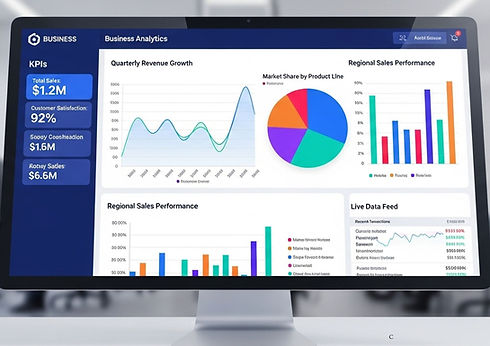

Business Intelligence
Software
Learn more about Business Intelligence and Analytics Software and the market options. What it is, what it does, who uses it, and the data vendors you need to speak to:
What is Business Intelligence Software?
Business intelligence software encompasses the platforms and tools that organisations use to collect, process, analyse, and visualise data in order to support better business decisions. It is a broad market, and the right solution for your organisation depends heavily on your data maturity, the technical capability of your end users, the complexity of your data environment, and what you are ultimately trying to achieve.
The main categories within business intelligence and analytics software include:
-
Enterprise BI and Reporting - traditional platforms that provide standardised, governed reporting across the organisation, typically managed by a central BI or data team. Market leaders include Microsoft Power BI, Tableau, Qlik, and MicroStrategy.
-
Self-Service Analytics - platforms designed to allow business users to explore data and build their own reports and dashboards without requiring IT or data team involvement. Usability and governance controls are key evaluation criteria in this category.
-
AI-Powered Analytics - next-generation BI tools that use artificial intelligence and natural language processing to allow users to query data conversationally, surface automated insights, and detect anomalies. ThoughtSpot is a leading example of this emerging category.
-
Embedded Analytics - BI capabilities built directly into other business applications (ERP, CRM, HR systems) to surface insights within operational workflows rather than in a separate analytics tool.
-
Decision Intelligence - platforms that go beyond visualisation to help organisations model decisions, assess trade-offs, and optimise outcomes using advanced analytics. Copperleaf is a notable player in this space.
-
Conversation Analytics - tools that analyse unstructured data from customer interactions, including call recordings and chat transcripts, to surface operational and customer experience insights. CallMiner is a leading example.
-
Augmented Analytics - platforms that use machine learning to automate data preparation, insight generation, and explanation, reducing the burden on data analysts and accelerating time to insight.
The boundaries between these categories are blurring rapidly, particularly as AI capabilities become embedded across the major BI platforms. Many organisations are also navigating the overlap between their BI platform and their broader data stack, including data warehouses and lakehouse platforms. Independent guidance is essential to avoid buying overlap or missing critical integration requirements.

Digital Experience Analytics Software
Learn more about Digital Experience Analytics Software and the market options. What it is, what it does, who uses it, and the data vendors you need to speak to:
Conversation Analytics
Software
Learn more about Conversation Analytics Software and the market options. What it is, what it does, who uses it, and the data vendors you need to speak to:


Enterprise BI and Reporting
Software
Learn more about Enterprise BI and Reporting Software and the market options. What it is, what it does, who uses it, and the data vendors you need to speak to:
Workforce
Analytics
Software
Learn more about Workforce Analytics Software and the market options. What it is, what it does, who uses it, and the data vendors you need to speak to:


Business Intelligence Vendor Content
Our analyst team publishes independent BI vendor profiles, category explainers, and market guides to help data and analytics leaders understand the landscape. The following are a strong starting point:
How to Find Business Intelligence Software
If you are at the early stage of a BI or analytics project and are not yet sure which tools or vendors to explore, our finding services help you bring structure and objectivity to that initial assessment.
-
BI Innovation Series - looking for new ideas? Our Innovation Series brings vendors and thought-leaders to present new ideas and technologies.
-
Stick or Switch Application Review - a great way to decide whether to continue with your existing software, or move elsewhere.

How to Select Business Intelligence Software?
Selecting a BI platform is more nuanced than most enterprise software decisions. The market is crowded, the differences between tools are often subtle, and the right answer is highly dependent on your specific data environment, user base, and analytics maturity. A platform that is excellent for a data-savvy analytics team can be overwhelming and under-adopted by a general business user population.
At a high level, any robust BI and analytics software selection process should address:
-
Defining your primary use cases before approaching vendors - enterprise reporting, self-service exploration, operational dashboards, and advanced analytics all place different demands on a BI platform
-
Profiling your end users - the technical sophistication of your primary user base is one of the most important factors in determining which platform is the right fit
-
Assessing your data architecture - your BI platform needs to connect cleanly to your data sources, whether that is a cloud data warehouse, an on-premise database, or a mixed hybrid environment
-
Evaluating governance and security requirements - particularly important for organisations in regulated industries or those handling sensitive customer or financial data
-
Considering the total cost of ownership - BI platforms vary significantly in licensing model, and the cost of training, implementation, and ongoing administration can dwarf the licence fee
-
Testing with real data and real users - BI software that looks impressive in a vendor demo can perform very differently when users are working with your actual data volumes and complexity
Evaluating vendor roadmap and AI capabilities - AI-powered analytics is transforming the BI market rapidly, and the platform you select today needs a credible path to meeting your analytics needs in three to five years

Selecting Business Intelligence
Software
Once you are ready to move into formal BI vendor selection, Viewpoint Analysis offers three distinct services depending on where you are in the process and how quickly you need to move.
-
Rapid RFI - From Longlist to Shortlist. Our Rapid RFI (RRFI) compresses the traditional BI vendor assessment timeline significantly. We manage the process end to end, engaging vendors on your behalf, evaluating responses against your requirements, and delivering a clear and justified shortlist of the most suitable BI and analytics options for your specific data environment and user base.
-
Rapid RFP - Our Rapid RFP (RRFP) takes your shortlisted BI vendors through a structured, fast-paced evaluation. We write the RFP document, host vendor qualification calls, manage Q&A sessions, and facilitate final demonstrations, bringing independent expertise to every stage and ensuring the evaluation stays objective throughout.
-
30-Day Selection - need to move even quicker? Our fastest selection process is completed in less than a calendar month!
FREE
Longlist
Builder
NEW - Not sure which BI and analytics vendors should be on your initial longlist? Our free Longlist Builder generates a tailored list of relevant vendors based on your specific use case, organisation size, data environment, and budget range. Answer a few questions and we produce a comprehensive report you can use as the starting point for your market assessment.


Useful Business Intelligence Selection Advice
The following Viewpoint Analysis resources are designed to help data and analytics leaders and IT teams run better technology selection processes:


Enterprise
Software
Selection
Playbook
Our Enterprise Software Selection Playbook 2026 is the most complete instructional guide to finding and selecting enterprise technology across any market. The structured approach to market assessment, RFI, RFP, and vendor evaluation applies directly to BI and analytics selections, particularly for teams who need to move faster than a traditional tool evaluation allows.ftware in any technology market or area of interest.

Frequently Asked Questions - Business Intelligence Software Selection
What is the difference between BI software and data analytics software?
The terms are often used interchangeably, but there is a useful distinction. Business intelligence software traditionally focuses on reporting on historical data - what happened? Analytics software goes further, exploring why it happened and what is likely to happen next. Modern BI platforms increasingly combine both, adding predictive and prescriptive analytics capabilities alongside traditional dashboards and reports. When we talk about BI software selection, we cover the full spectrum.
We already have Microsoft Power BI - should we consider alternatives?
Microsoft Power BI is a strong platform and the right choice for many organisations, particularly those already invested in the Microsoft ecosystem. But it is not the right answer for everyone. Depending on your data volumes, user sophistication, governance requirements, and analytics ambitions, tools like Tableau, Qlik, ThoughtSpot, or specialist platforms may serve you better. Our Stick or Switch review is specifically designed to give you an independent, evidence-based answer to this question.
How do we evaluate BI software properly - the demos all look impressive?
This is one of the most common challenges in BI selection. Every vendor demo is built to impress, using clean sample data and pre-configured scenarios. The key is to evaluate with your own data, against your specific use cases, with your actual users involved in the assessment. Our Rapid RFI and RFP processes are structured to force exactly this kind of evidence-based evaluation, cutting through the demo theatre to focus on what matters.
Do you cover embedded analytics and specialist analytics tools as well as mainstream BI platforms?
Yes. We cover the full BI and analytics market, including embedded analytics, decision intelligence, conversation analytics, augmented analytics, and specialist vertical tools. We are not limited to the mainstream Gartner Magic Quadrant vendors. If there is a BI or analytics tool that could be the right fit for your use case, we will include it in the assessment.
How quickly can you complete a BI software selection?
Our Rapid RFI and Rapid RFP processes typically complete in six to eight weeks end to end. For organisations with very tight timelines, our 30-Day Technology Selection delivers a preferred vendor decision in under a calendar month. Both are significantly faster than a traditional BI tool evaluation, which can drag on for three to six months when managed internally.